
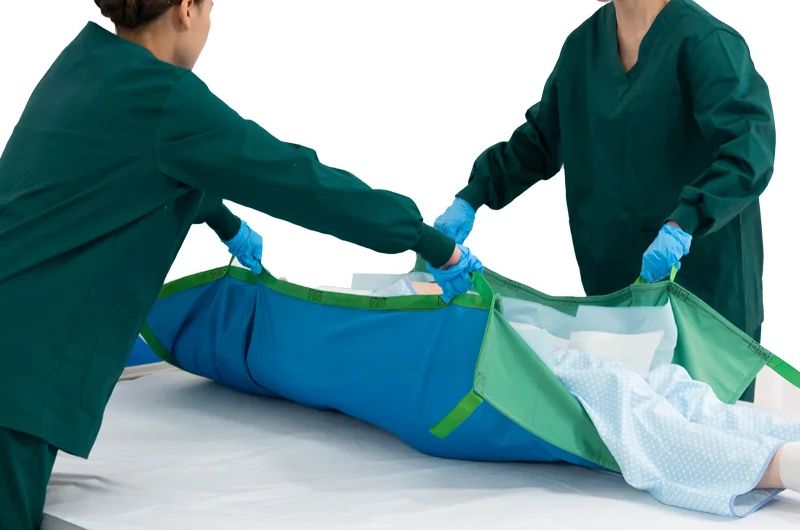
Healthcare professionals dedicate their careers to caring for others, yet the physical demands of their job—particularly patient handling—make them among the highest-risk professions for occupational injury. In fact, nursing and related healthcare roles account for some of the highest rates of musculoskeletal disorders (MSDs) in any industry. While lifting equipment and ergonomic protocols are critical, one often-underestimated tool plays a transformative role: the transfer sheet. Used correctly, these low-friction devices can dramatically reduce the physical strain of patient movement, preventing injuries that lead to chronic pain, lost wages, and early career burnout. This post examines how transfer sheets contribute to a safer workplace and healthier workforce.
1. The Hidden Epidemic: Patient Handling Injuries in Healthcare
Patient handling is not merely a task—it is a biomechanical challenge that repeats dozens of times per shift. Manual lifting, repositioning, and transferring expose caregivers to forces that can exceed safe thresholds, especially when patients are immobile, bariatric, or confused. Common injuries include lumbar strains, herniated discs, rotator cuff damage, and cervical spine stress. Beyond immediate trauma, cumulative micro-trauma leads to degenerative conditions and chronic fatigue.
The consequences ripple across the entire healthcare ecosystem:
- Personal cost: Pain, disability, and reduced quality of life for the caregiver.
- Organizational cost: Workers' compensation claims, litigation, and higher insurance premiums.
- Patient care impact: Staff shortages, turnover, and compromised team morale.
2. How Transfer Sheets Work: Simple Physics, Powerful Protection
Transfer sheets are engineered from low-friction materials like nylon or silicone-coated fabrics. Placed beneath the patient, they create a sliding layer that minimizes resistance during repositioning, lateral transfers, or bed-to-stretcher moves. This physical principle makes a significant difference:
- Friction reduction: The coefficient of friction between a patient and standard bedding can create substantial drag. Transfer sheets reduce this force by up to 50%, meaning caregivers no longer have to exert extreme pulling or lifting effort.
- Shear force mitigation: Shear occurs when layers of skin and tissue move in opposite directions. Transfer sheets reduce shear not only on the patient's skin but also on the caregiver's joints and muscles, preventing microtears and strains.
- Leveraging mechanical advantage: With less friction, the weight of the patient is effectively reduced during lateral moves, allowing a single or paired caregiver to perform tasks that previously required three or four staff members.
3. Transfer Sheets and Ergonomics: A Natural Partnership
Ergonomic technique is the cornerstone of injury prevention, but even the best body mechanics cannot overcome excessive force. Transfer sheets bridge that gap:
- Promoting neutral spine posture: With less resistance, caregivers can maintain a straight back and use their leg muscles rather than bending at the waist.
- Reducing awkward reaches: The sheet allows the patient to be moved closer to the caregiver's center of gravity, eliminating the need for outstretched arms that place torque on the shoulders.
- Facilitating coordinated moves: When two caregivers work together, the sheet reduces the need for jerky, uncoordinated efforts, allowing smoother, more predictable movements.
4. Integrating Transfer Sheets into a Safe Patient Handling Program
No single tool is a silver bullet. Transfer sheets deliver maximum benefit when embedded in a comprehensive safe patient handling and mobility (SPHM) program:
- Assessment protocols: Use algorithms to match patient dependency level with the correct device. For low- to moderate-assistance patients, transfer sheets are often ideal.
- Staff training: Teach proper placement, gripping techniques, and teamwork strategies. Hands-on practice is essential.
- Equipment availability: Ensure transfer sheets are stocked in every patient room and on every unit—not just in the supply closet. Accessibility increases utilization rates.
- Culture of safety: Encourage peer support and reporting of injury near-misses. When caregivers see transfer sheets as part of a safety culture, adoption soars.
5. The Ripple Effect: Safe Caregivers, Better Outcomes
Investing in transfer sheets creates a virtuous cycle:
- Staff retention: When nurses feel protected, they stay longer. Reduced turnover means lower recruitment costs and more experienced teams.
- Efficiency gains: A safe transfer takes less time than an unsafe one. Less time spent struggling means more time for direct patient interaction.
- Patient dignity: Smooth, controlled transfers minimize patient anxiety and discomfort. Patients feel safer when their caregiver appears calm and capable.
6. Conclusion: A Small Investment with a Large Return
Transfer sheets are not a luxury—they are a standard of care for both patients and the professionals who care for them. Their low cost and high impact make them one of the most accessible tools for preventing occupational injuries. When combined with training and a culture of safety, these simple sheets can reduce injury rates, improve staff wellness, and enhance patient trust. Protecting healthcare worker health is not merely an operational goal—it is a moral imperative. Start with the simple transfer sheet, and build a foundation for lifelong career safety.